I’m alive

Standard

Bogotá, Colombia

27 November-1 December 2012

Christmas tree set up in Plaza de Bolivar

Christmas tree set up in Plaza de Bolivar

Being on the other side of the world, us Australians seem to have a lot of preconceptions about Colombia, and in particular, it’s capital, Bogotá. I think that this is mostly because the news that we read about in Australia is mostly to do with kidnappings and massacres and other fun stuff. This is not at all helped by the Smartraveller website, which offers a shopping list of terrorist attacks that have occurred over the past few years, many of which in Bogotá, the most recent being a car bombing in May.

So amidst all this doom and gloom, shortly after LAN 572 from Santiago de Chile landed late on Tuesday night, in the short journey from the airport to the nights lodgings, I very much expected to get murdered, or drugged, or taken on the apparently not uncommon paseo millonario, where passengers are taken at gunpoint by the taxi driver or his accomplices to a plethora of ATM’s to ensure that your bank account is drained, and your holiday ruined. (For the record, a million Colombian pesos is about $530, but still slightly higher than the typical monthly wage.)

Talk to the hand

Talk to the hand

As such, I was pleasantly surprised when after a couple days of touring around the city, much of it solo, I had not been the victim of crime, violent or otherwise. Perhaps more surprisingly, I hadn’t really seen any crime. In fact, the worst I had witnessed was a local jumping the ticket barrier at a TransMilenio station – a sight encountered in any city. Police are very common throughout the city, even if many of them are just high school graduates completing their compulsory national service.

During the day time and into the early hours of the evening, Bogotá, or at least the parts I visited, seemed fine. I encountered only the odd beggar, and even then they appeared to be less common than Brisbane. Everyone was well dressed, in the hustle and bustle of their daily life. From the moment I had a conversation in very broken español with the taxi driver, I could tell that the Bogotanos are very optimistic about the future for their city and country. It wasn’t really written anywhere, just an intangible feeling I sensed from many sources.

The whole city seemed normal, and perfectly functioning, perhaps a function of its single digit unemployment rate. And while the city itself is wonderful and enthralling, it kind of lacks a major drawcard to the tourist – other than an insight into the daily life of the typical hard-working Colombian. Which in addition to Colombia’s reputation, is probably why you don’t see too many ‘regular’ tourists traipsing around the place, with most gringos being fellow young travellers. Which is a shame, because the city is actually quite nice.

Carrera 7 closes for a street fiesta every Friday and Sunday night

Carrera 7 closes for a street fiesta every Friday and Sunday night

Ways I beat jet lag

Standard

My trip to South America had me travelling continuously door to door for 33 hours, on three flights, crossing ten time zones. I arrived free of jet lag to maximise the time abroad. How did I do it?

1. Develop a workable sleeping plan

I find that staying up when I need to is a lot easier than going to sleep on demand when I am not tired. Staying up all night the night before my travel allowed me to delay the bulk of my sleep for the 11 hour Trans-Pacific flight from Auckland to Santiago. This way, I woke up at about 7am in the local time of my ultimate destination, Bogotá. Bingo, already adjusted my body clock.

2. Actually sleep on the plane

Which I found to be quite easy, on LAN’s business class camas, complete with fluffy pillows and warm doonas.

The amazing transformer chair - the sleep was amazing

The amazing transformer chair – the sleep was amazing

My world tour is almost here

Standard

In early June 2012, I booked myself a trip around the world to visit a part of the world I had long wanted to visit. The itinerary was bare, as it contained only intercontinental flights and featured long, empty surface sectors between distant airports. I had planned six weeks in South America, two weeks in North America, one week in Europe, and three days in Hong Kong.

And then I sat on it and dwelled, for months.

Fast forward to now, and I am exactly four weeks shy of my departure date at 8:10am November 27 where I travel to Bogota, Colombia. I am frantically piecing together integral must-do components of my trip, such as clases de Español, hiking the Inca trail, viewing Aurora Borealis and Niagara Falls.

I created a budget to give me an idea of how much I thought I’d need for the trip. Numerous vague assumptions later, I came up with a figure so large I refused to believe it. So I did. And now I regret doing so as thousands of dollars pour out of my bank account to pay deposits for tours and accommodation with little trickling in to replenish the stream. It’s much like a financial El Niño, minus the water restrictions (to Australia, at least).

And I just discovered yesterday that to save $800 in flights, I have to send away my passport to get myself a Brazilian visa and jump through the administrative hoops amid pressing deadlines.

The planning is frantic, yet exhilarating and enjoyable at the same time. I hope the trip itself is more so!

So in short, I don’t have everything sorted, lack the required visas for everywhere I plan to go, have no idea how I will afford it all, but I am very, very excited.

It’ll be the time of my life.

Virgin’s ATR72 – basically a back-to-front Q400

Standard

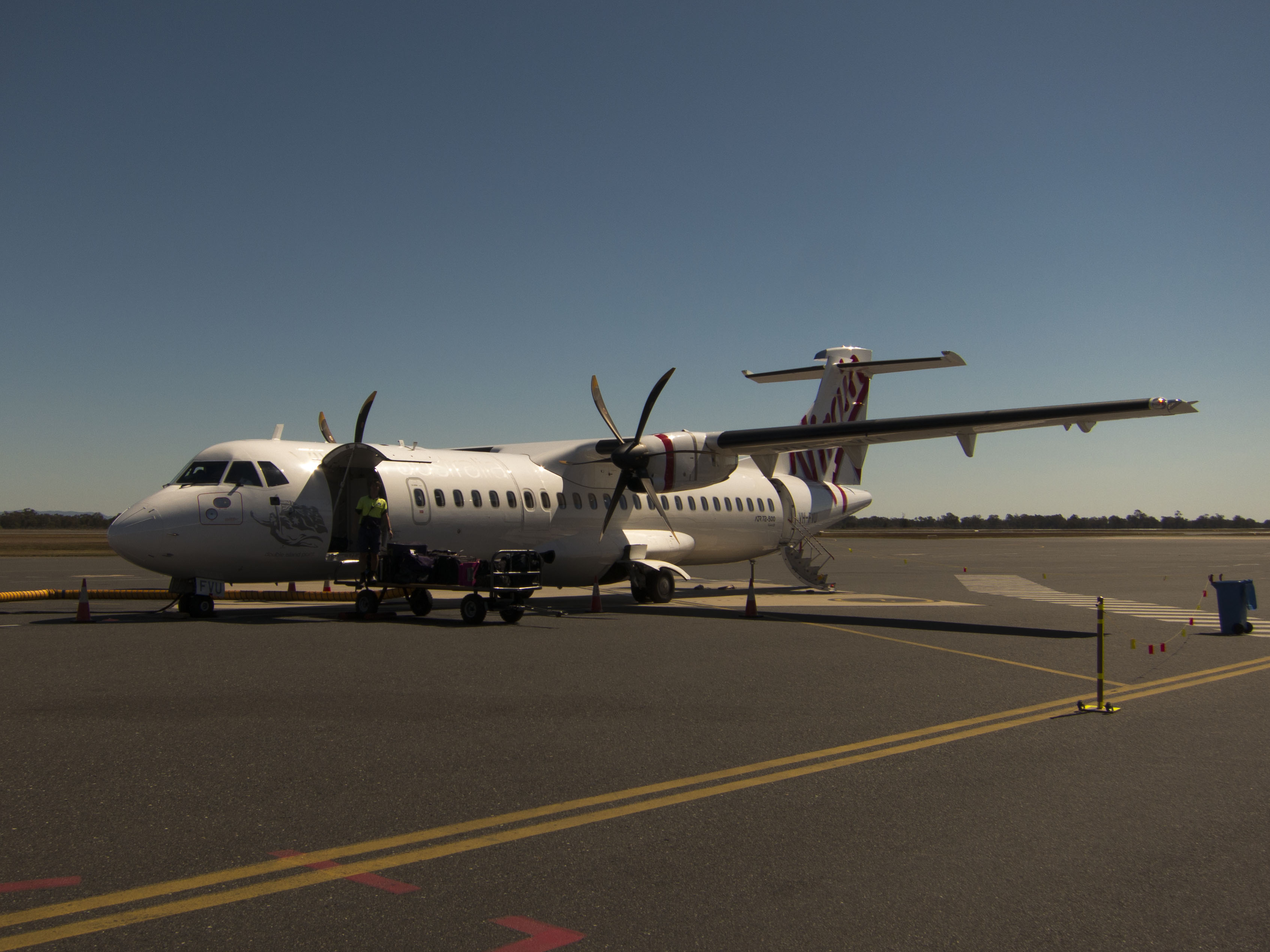
ATR72-500 at Rockhampton Airport

Here it is, my first trip aboard the ATR72-500, a French-Italian collaboration introduced to Australia by Virgin Australia, through operating partner Skywest, to more cheaply compete with Qantaslink’s Bombardier Q400’s on regional routes. The trip today was Rockhampton to Townsville where Virgin have launched a non-stop daily service to compete with Qantaslink’s twice-daily-but-never-on-time milk run via Mackay.

My first impressions were the same as that of every other ATR virgin. Rear door boarding? Huh? The aircraft is quite unique in that the aircraft places the luggage hold as a barrier between the flight deck and the passenger cabin. A few possibilities ran through my mind as to why this is the case. Flight deck security considerations? Shifting the people rearward achieves a better weight balance?

Regardless, it removes the motivation to instinctively pick the front rows of the plane, as you have to balance the quieter, more

View from Row 4

comfortable ride and prestige of having a low row number against the very practical benefit of sitting at the back of the bus and being first off.

For what it’s worth, I picked row 4, not sure why. I just liked the number.

Perhaps it’s some psychological mind game played that gets people get on and off planes faster? Because, let’s face it Virgin need all the loading efficiencies they can get. There’s no two ways about it, this plane is slooowwwww.  The plane has a cruising speed roughly three-quarters that of the Q400, and 40% slower than the Embraer jet that Virgin used to fly on this route, and by doing that, you heavily begin to erode the time savings that the non-stop service brings.

But the serious uptick for Virgin is that by going slow and burning less fuel, you have quite the efficient little plane. A Virgin engineer once told me that the break-even point for these planes are roughly 35 passengers, or only half full, which gives the airline plenty of room to move on pricing, and allows them to justify spending more time letting the market on thin routes against an incumbent operator like Rockhampton to Townsville mature and grow.

Back to the plane, as a relatively tall person, I didn’t fit very well. When standing up straight, I could just touch the ceiling while walking down the aisle, and walking down the aisle felt like a real life version of the board game Operation as I dodged the opened doors of the overhead compartments.

One false step, and BAM! Brain damage. Something I luckily managed to avoid.

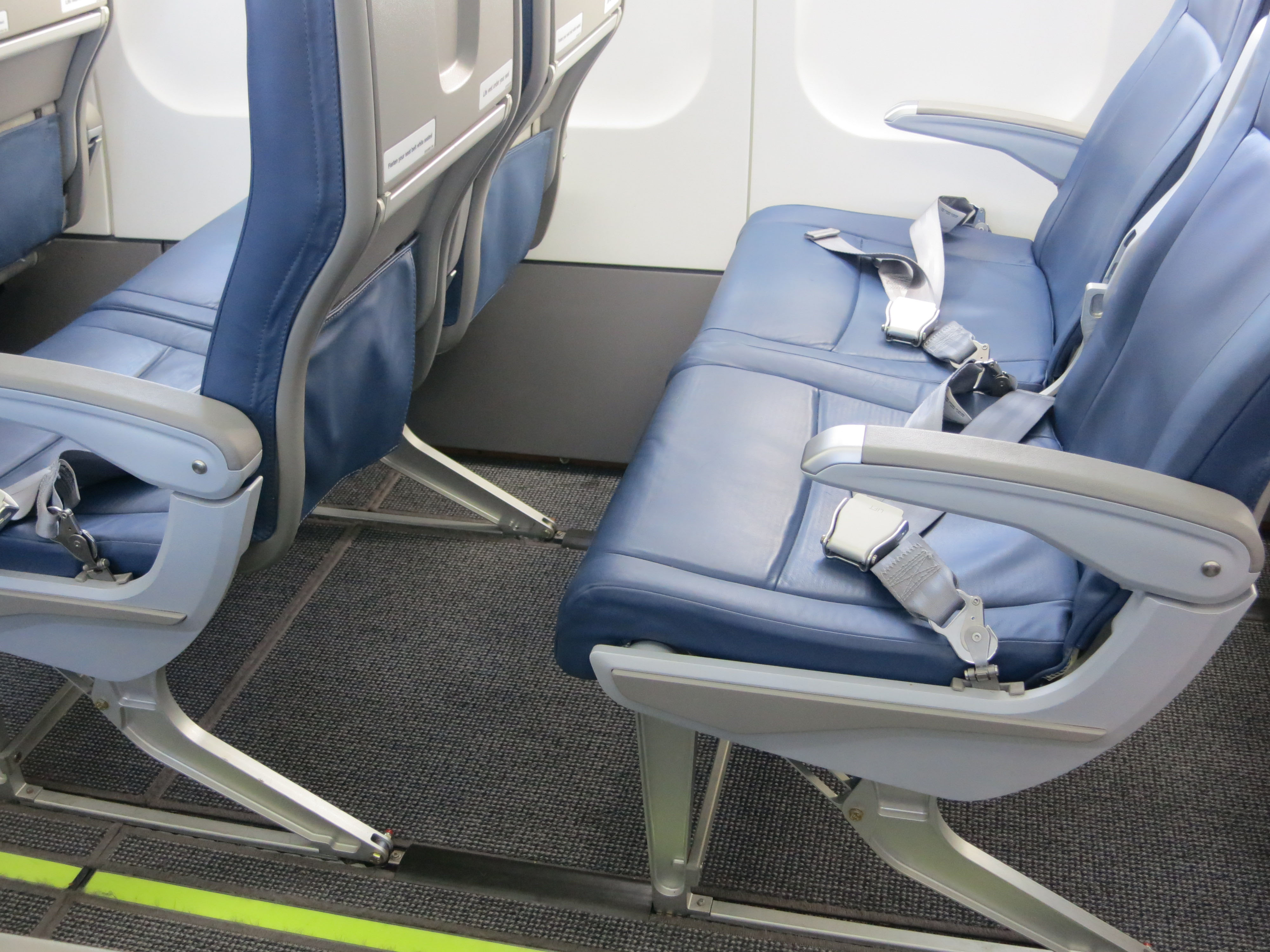
The usual 30-inch seat pitch sardine can

In terms of passenger comfort, there superficially felt no difference between the Q400 and the ATR, both have cramped blue leather seats, boarding music (though the ATR didn’t feature the Boy and Bear cover of Fall at Your Feet), and a vomit bag, among other similarities. The biggest difference is that the cabin in the latter feels slightly more claustrophobic with the lower headroom, but makes up for it with the superiority of having window shades. In lieu of a full buy-on-board catering service, we were offered biscuits and cheese, with a water or juice.

All in all, and uneventful flight.

The orange cancer that saved Easter

Standard

8 April 2012

I was ready to hate Jetstar and swear never to travel with them again.

Especially after the flight to Japan in which they reneged on the paid seating allocation and placed us in middle seats – we were eventually given aisle seats in the back row of the plane, right next to the toilets. And then forgot our food and drinks, and then when finally offered, did not provide a choice.

But check-in for my trip home was the ultimate slap in the face. In contrast to standard practice for long-haul overnight flights, I wasn’t entirely dreading this trip as, you see, I had managed to take advantage of a fortuitous business class sale, which meant I got myself into the pointy end of the plane for just $80 more than an economy seat on the same flight.

But panic ensued as the third-party check-in agents tried every possible means of finding my booking, without success. My troubles were escalated to the manager, the only person at the whole airport actually employed by Jetstar, who let me know that, in a stunning disconnect between what was booked and what was offered, I was in the wrong check-in queue as my booking showed me in economy class.

Oh, and I was in the wrong city too. Apparently, I was departing that night from Osaka, not Tokyo, which was news to me.

While I got what I paid for back in the end, it was a complete waste of half an hour that could have been better spent drinking $80 worth of scotch in the lounge. The check-in manager was apologetic, but not forthcoming with compensation, with the exception of a tiny fold-up stool to sit on in the check-in hall that made me feel like a little person.

But then I received a surprise. The inclusion of a Lindt chocolate egg on the dinner tray of my Easter Sunday red-eye flight home.

Lindt Easter Egg

Artists Impression of Lindt Easter egg - do not attempt to print and eat

Easter was an event I had simply forgotten about this year. With Christianity being the religion of only a very small minority of Japanese, the locals go about their daily business completely oblivious to the fact that more than billions of people worldwide are enjoying a holiday, regardless of whether they are Christian or otherwise. It is a little surreal when you realise that an event observed ritualistically every year since birth suddenly ceases to exist, barely noticing it’s passing.

It is also amusing watching the Japanese man next to me staring at the red ovoid with an inquisitive glance, his eyes silently questioning it’s significance.

He chooses not to eat it, and sleeps instead. Which was convenient, because it meant I could have two.